


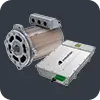


POWER DISTRIBUTION UNIT
Power Distribution Units in electric vehicles are electronic devices that manage and distribute electrical energy within the vehicle. Their main function is to receive energy from the main battery and distribute it to the various systems of the vehicle, such as electric motors, the charging system, air conditioning devices and other electronic components. Q-tronic works closely with Covi Electric in the development of customer-specific PDUs

Main Functions

Energy Distribution
Distributes energy from the battery to the vehicle’s other electrical and electronic components, regulating the amount of energy each system receives as needed.

Motor Control
It manages the energy that powers the electric motor and various auxiliary systems such as lights, heating, air conditioning and infotainment.

Performance Optimization
Improves vehicle efficiency by ensuring energy is optimally distributed to extend vehicle range and significantly improve operational reliability.

Monitoring
It constantly monitors energy levels and the status of electrical system components, preventing overloads and short circuits.

Charge Management
Coordinates battery charging, ensuring that current is delivered correctly and safely by the charging management system.

Protection
It intervenes to temporarily deactivate circuits, protecting the vehicle from potential electrical damage and failures.
Typical components of a PDU in an Electric Vehicle:
- Cables and Connections
- BMS
- Fuses and Protection Devices
- Pre-Charge
- Current and Voltage Measurement
- HVIL (High Voltage Interlock Loop)
- Shielding
- Control and Monitoring Units
- Contactors and Connectors
In summary, the PDU is essential for the safe and efficient management of energy in an electric vehicle, allowing optimal and controlled distribution of energy between the various components of the vehicle’s electrical system.

Standard Models
| Features | Model S | Model M | Model L | Model XL |
|---|---|---|---|---|
| Voltage | Up to 48VDC | Up to 96VDC | Up to 450VDC | Up to 800VDC |
| Rated Current | 300A | 300A | 500A | 500A |
| Max Input | 2 | 2 | 3 | 3 |
| Power Output | 4 | 4 | 5 | 5 |
| Auxiliary Output | 3 | 3 | 3 | 3 |
| Auxiliary Voltage | 12V / 24V | 12V / 24V | 12V / 24V | 12V / 24V |
| Fuse Protection | Positive pole | Positive pole | Positive pole | Positive pole |
| Equipotential Connection | – | ✓ | ✓ | ✓ |
| Pressure Compensation | ✓ | ✓ | ✓ | ✓ |
| Temperature Range | -20 to 50°C | -20 to 50°C | -20 to 50°C | -20 to 50°C |
| IP & IK Level | IP66 / IP67 | IP66 / IP67 | IP66 / IP67 | IP66 / IP67 |
| Insulation Monitoring Device | – | ✓ | ✓ | ✓ |
| HVIL | – | ✓ | ✓ | ✓ |
| Electronic Control Unit | – | Optional | ✓ | ✓ |
| Precharge / Discharge Circuit | – | ✓ | ✓ | ✓ |
| DC Contactor | Optional | ✓ | ✓ | ✓ |
| Temperature Sensor | – | Optional | ✓ | ✓ |
| Current / Voltage Sensor | – | Optional | ✓ | ✓ |
| Communication | Optional | Optional | CAN Open / SAE J1939 | CAN Open / SAE J1939 |
| Connection Type | EMC Cable Gland | EMC Cable Gland | PowerLock Connector | PowerLock Connector |
Why Install a PDU for Your Vehicle?
The PDU is a strategic element to optimize energy management, improve vehicle reliability & ensure compliance with safety regulations.
A well-designed PDU ensures precise and intelligent distribution of energy, powering all the main systems of the vehicle, from electric motors to auxiliaries such as lights and climate control.
This approach not only protects the system from overloads and short circuits thanks to constant monitoring the circuits, but also allows to maximize the overall efficiency, extending the operating autonomy.